Kitesurfing in Sri Lanka. Your Guide.
Flat lagoons, consistent wind, and warm water year-round: Sri Lanka is one of the best-kept secrets for kitesurfers worldwide. This guide helps you plan the right trip, whether you're just learning or already riding.
A note on this guide: Most kitesurfing guides for Sri Lanka are written by large kite camps competing for your booking. This one comes from Ruuk Village: a small eco-lodge right on the lagoon that has been doing things differently for over 14 years. We are not the biggest. We are not the cheapest. But if you value space, calm, and real progress over a kite-factory experience, this guide will help you plan the right trip.
What makes Sri Lanka special for kitesurfing
Sri Lanka sits in the path of two monsoon systems, delivering reliable wind nine months of the year. But wind alone does not make a great kite destination: the lagoon system in Kalpitiya does.
While most kite spots worldwide offer either wind or flat water, Kalpitiya delivers both. The shallow lagoons (waist-deep in many areas) provide butter-flat conditions that are rare globally. For learners, this means faster progress. For experienced riders, it means uninterrupted sessions without chop.
Flat Water Lagoons
Waist-deep, butter-flat water: globally rare. Perfect for learning and freestyle.
Warm Year-Round
28°C water and air. No wetsuit needed. Board shorts and rashguard are enough.
More Than Kitesurfing
Dolphins, wildlife safaris, yoga, cooking classes. Partners and non-kiters stay happy.
Add to that the cultural depth of Sri Lanka: ancient temples, wildlife parks, and authentic village life. This makes it a destination worth staying longer than a typical kite trip.
Discover activities beyond kitesurfing →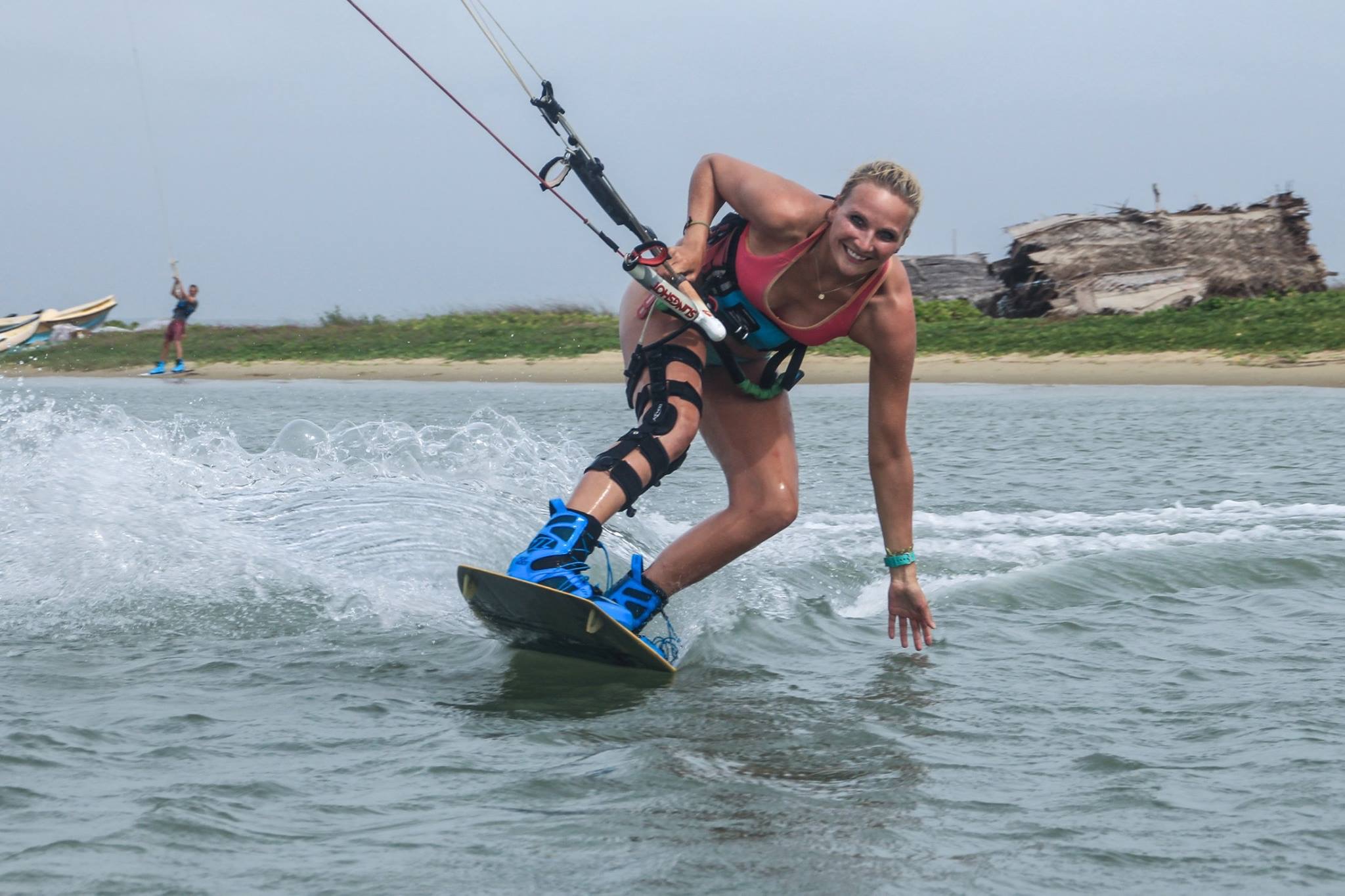
The Kalpitiya lagoon at golden hour: flat water as far as the eye can see.
Kitesurfing seasons in Sri Lanka: two vibes, one destination
Sri Lanka's kitesurfing calendar splits into two distinct seasons, each with its own character. Understanding which suits your level and style helps you book the right dates.
Summer Season
May to OctoberThe main season. The southwest monsoon brings consistent 18 to 30 knot winds almost daily. This is when Kalpitiya comes alive: all kite schools operate at full capacity, and conditions suit everyone from beginners to pros.
- Wind: 18 to 30 knots, cross-onshore
- Best for: All levels, especially intermediate+
- Crowd level: Busier, but Kalpitiya never feels crowded
- Vibe: Social, energetic, full service
Winter Season
December to MarchThe gentler season. The northeast monsoon brings lighter, more variable winds (12 to 20 knots). Perfect for beginners who want consistent but manageable conditions, and for foilers who thrive in lighter wind.
- Wind: 12 to 20 knots, more variable
- Best for: Beginners, foilers, those seeking quiet
- Crowd level: Very relaxed
- Vibe: Quieter, more reflective
Where to kite in Sri Lanka
While there are a few spots around the island, Kalpitiya is the undisputed center of Sri Lankan kitesurfing. The lagoon system here offers multiple spots for different conditions and skill levels.
Kalpitiya Lagoon
All LevelsThe main spot. Huge, waist-deep lagoon with butter-flat water. Most kite camps are located here, including Ruuk Village. Cross-onshore wind during both seasons. Ideal for learning and freeriding.
Vellai Island
Intermediate+An uninhabited island accessible by boat. Pristine beach, no crowds, perfect conditions. We offer kite safari day trips to Vellai that include boat transfer, lunch, and a guide.
Dream Spot
Intermediate+A remote section of the lagoon with more consistent wind and less traffic. Accessible by jeep or boat. Popular with experienced riders looking for undisturbed sessions.
Kappalady and Puttalam Lagoon
All Levels / Intermediate+Kappalady is about 30 minutes south of Kalpitiya Town and offers a smaller, beginner-friendly lagoon with consistent wind. The large Puttalam Lagoon is better suited for intermediate riders and best explored with a guided tour from a local school.
Why Sri Lanka is ideal for beginners
Kalpitiya is considered one of the best places in the world to learn kitesurfing. The combination of flat water, consistent wind, and warm climate creates conditions that accelerate learning and minimize frustration.
Unlike beach spots where waves and currents complicate learning, Kalpitiya's lagoons let students stand up when things go wrong. The waist-deep areas mean you can recover your kite without swimming, focusing on technique rather than survival.
What to expect
- Day 1 to 2: Kite control, body drag, safety exercises
- Day 3 to 4: Water start, first rides
- Day 5+: Independent riding, practicing turns
Most students ride independently within 3 to 4 days of instruction. That is significantly faster than most other destinations.
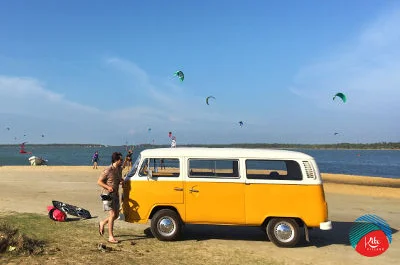
Kite lessons in waist-deep water: stand up instead of swimming.
Kite gear: bring your own or rent locally?
One of the most common questions we get. Is it worth bringing your own gear, or renting on site? The answer depends on your situation.
Rent locally
- Current gear (we ride CrazyFly)
- No excess baggage at the airport
- Try different setups
- Ideal for stays up to 2 weeks
Cost: From USD 45/day for a complete set (kite, board, harness)
Bring your own
- Your trusted setup
- No dependency on availability
- More affordable for longer stays
- Budget for excess baggage (~USD 50 to 80 per leg)
Recommended for stays over 2 weeks or during peak season.
Where to stay for kitesurfing in Kalpitiya
Accommodation in Kalpitiya ranges from simple guesthouses to large kite camps with 60+ guests. What is right for you depends on what you are looking for beyond the kiting, or whether kiting is even the main reason you are coming.
What is available in Kalpitiya
Large kite camps offer an all-in-one package: accommodation, school, rental, and a social programme. This works well if you want a lively atmosphere and do not mind sharing the spot with many other kiters.
Guesthouses are cheaper, but you organize everything yourself: transport, equipment, meals. For experienced kiters with their own gear, this can work; for beginners or rental setups, it is less practical.
Where Ruuk Village fits
Ruuk Village does not fit neatly into either category. We are not a large kite camp, and not a polished resort either. What we are: a small, intentionally simple place right on the lagoon, grown over 14 years together with the local community. Some guests come to kitesurf, others are looking for a quiet starting point for Sri Lanka, and many come simply to find some stillness again.
This is not for everyone. If you expect a resort with a pool or want to party in the evening, you will not be happy here. But if you are looking for space, calm, and genuine connection, you will feel at home with us.
- 10 cabanas, max. 20 guests intentionally small
- Direct lagoon frontage no transfer, no jeep
- Open-fire kitchen local ingredients, shared meals
- Local team fairly paid, year-round, with us from the start
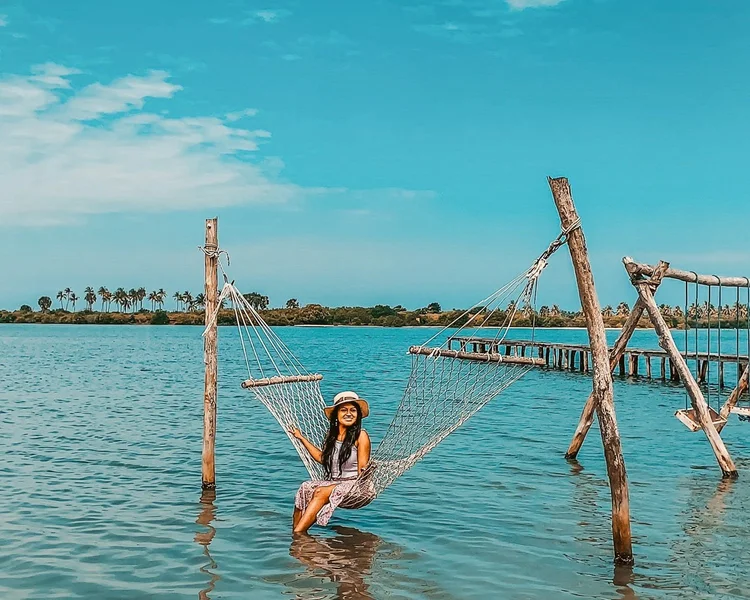
Ruuk Village: 10 cabanas, direct lagoon frontage, over 14 years.
What to do on no-wind days and for non-kiting partners
Even during peak season, there are occasional light-wind days. And if you are traveling with a non-kiting partner, Kalpitiya and its surroundings offer plenty to keep everyone happy. From wildlife to wellness.
Dolphin and Whale Watching
Kalpitiya is one of the best places in Sri Lanka to see spinner dolphins: pods of hundreds in their natural habitat. Blue whales and sperm whales also pass through seasonally.
Wilpattu Safari
Sri Lanka's largest national park, about 90 minutes from Kalpitiya. Leopards, elephants, bears, and hundreds of bird species. Our tip: the boat ride via the rear entrance at Elluwankulam. A route almost no tourist knows. Half-day and full-day tours available.
Sri Lankan Cooking Class
Learn authentic Sri Lankan cuisine from our local team. From market to plate. Rice and curry the way it should be.
How to get to Kalpitiya
From Colombo Airport
Kalpitiya is about 150 km north of Colombo (3 to 4 hours by road). Most guests arrange a private transfer from the airport. We are happy to help with booking.
- Private transfer: ~USD 80 to 100, direct to accommodation
- Bus + tuk-tuk: Cheaper (~USD 15), but 5+ hours with changes
- Rental car: Possible, but left-hand traffic and chaotic driving make it stressful
Visa
Most nationalities can obtain an ETA (Electronic Travel Authorization) online before departure or on arrival. Valid for 30 days, extendable to 90 days.
Current info: eta.gov.lk
Best Flight Connections
Direct flights to Colombo (CMB) are available from most major hubs. Popular airlines:
- SriLankan Airlines: Direct from London, Frankfurt, Paris
- Emirates: Via Dubai, often affordable
- Qatar Airways: Via Doha, excellent service
- Turkish Airlines: Via Istanbul, many connections
Tip: Overnight flights are practical: you land in the morning and can be in Kalpitiya by afternoon. No lost day.
Kitesurfing Sri Lanka: frequently asked questions
What is the best time to visit Sri Lanka for kitesurfing?
The summer season (May to October) offers the most consistent wind at 18 to 30 knots almost daily. The winter season (December to March) has lighter, more variable wind (12 to 20 knots) that suits beginners and foilers better.
Can complete beginners learn to kitesurf in Sri Lanka?
Yes, Kalpitiya is one of the best places in the world to learn. The flat, shallow lagoons mean you can stand up when things go wrong, and there is no surf to fight against. Most people ride independently within 3 to 4 days of lessons.
Do I need to bring my own kite equipment?
Not necessarily. All established kite camps rent current equipment. Bringing your own makes sense if you are picky about your setup, staying longer than 2 weeks, or want guaranteed availability during peak season.
What kite sizes work in Kalpitiya?
Summer (May to October): Most people use 9 to 12m kites. Lighter riders may need a 7m for stronger days. Winter (December to March): Larger kites needed, 12 to 15m depending on your weight.
Is Sri Lanka safe for solo travelers?
Yes. Sri Lanka consistently ranks as one of the safest countries in Asia for tourists. Kalpitiya is a quiet fishing region with very low crime. Solo travelers visit regularly without issues.
What if my partner does not kite?
Kalpitiya offers plenty of activities for non-kiters: dolphin safaris, Wilpattu National Park, yoga, cooking classes, boat trips, and simply relaxing by the beach. Many couples visit us with one partner kiting and the other enjoying the surroundings.
How long should I stay in Kalpitiya?
Minimum 5 to 7 days for kiting. Ideal is 10 to 14 days: enough time for kiting plus excursions (dolphins, safari, temples). Many guests stay 2 to 3 weeks and combine Kalpitiya with other parts of Sri Lanka.
What does a kite trip to Sri Lanka cost?
Rough orientation per week: flights from Europe USD 400 to 700, accommodation in a kite camp USD 40 to 100/night, rental USD 45 to 60/day, lessons USD 60 to 80/hour, food USD 10 to 25/day. Sri Lanka is significantly cheaper than the Caribbean or Europe.
How is the WiFi and connectivity?
Kalpitiya is rural. Do not expect fiber speeds. Most accommodations have WiFi that works for emails and basic browsing. For more reliable internet, we recommend getting a local SIM card with a data package (cheap and widely available, e.g. Dialog or Mobitel).
Can I combine kiting with traveling Sri Lanka?
Absolutely. Many guests spend 1 to 2 weeks kiting in Kalpitiya and then explore the Cultural Triangle (Sigiriya, Kandy, Dambulla), the train ride to the hill country, or the south coast. We are happy to help with route planning.
Can I go wingfoiling in Kalpitiya?
Yes, Kalpitiya is an excellent spot for wingfoiling. The flat lagoons and consistent wind provide ideal conditions. Several schools in the area offer wingfoil lessons and rental. Ruuk Village does not currently offer wingfoiling, but we are happy to connect you with a nearby school.
Find out if Ruuk Village is right for you
We are not for everyone. Our short fit test helps you figure out if our approach matches what you are looking for.